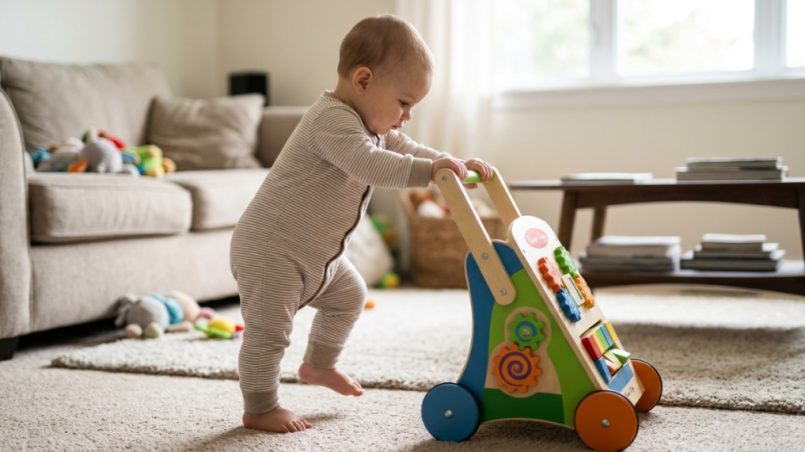
Watching your baby take those first wobbly steps is a milestone filled with equal parts excitement and anxiety. You want to encourage their independence, but you also worry about falls and frustration. The problem is that many parents rush into using the wrong support tools.
inadvertently delaying or even hindering their child’s natural walking development. The key lies in understanding how push-walker baby balance development works and choosing the right tool to support it. A push walker, when used correctly, transforms wobbly attempts into confident strides by building core stability and coordination. This guide will show you exactly how to select and use a push walker to turn those first steps into a successful journey.
What Makes a Push Walker Different From a Traditional Baby Walker?
A push walker is a stationary support toy that your baby stands behind and pushes forward as they walk. Unlike traditional seated walkers, which can restrict hip movement and create unsafe momentum, push walkers promote an upright, natural walking stance. This distinction is critical because a traditional walker often teaches babies to glide on their toes, whereas a push walker encourages a heel-to-toe gait. Think of a push walker as a set of training wheels for walking—it provides just enough support to build confidence without creating a crutch that bypasses the muscle development your child needs.
When Should You Introduce a Push Walker to Your Baby?
Introduce a push walker when your baby can pull themselves up to stand and cruise along furniture with support, typically between 9 and 12 months. If you put a push walker in front of a baby who cannot stand unsupported, they will likely just sit down and chew on it. Wait until your baby demonstrates “tripod standing”—where they can balance on two feet while holding something with one hand. This readiness ensures the walker is a training tool, not a distraction. Introducing it too early can lead to frustration and reinforce poor balance habits, as the child may lean heavily forward rather than engaging their core muscles.
How Does a Push Walker Support Baby Balance Development?
A push walker supports balance development by providing a stable, wide base that shifts your baby’s center of gravity naturally. When your child pushes the walker forward, their body responds by activating hip stabilizers and core muscles. This creates a feedback loop: the walker moves, the child adjusts their weight, and balance improves with each step. Over time, the walker teaches anticipatory balance—the ability to lean forward without falling. The handles help your child learn to shift weight from one leg to the other, which is the fundamental skill behind independent walking. Without this device, many babies skip this crucial weight-shifting practice and compensate by using their arms for balance, which delays walking confidence.
What Features Should You Look for in a Push Walker?
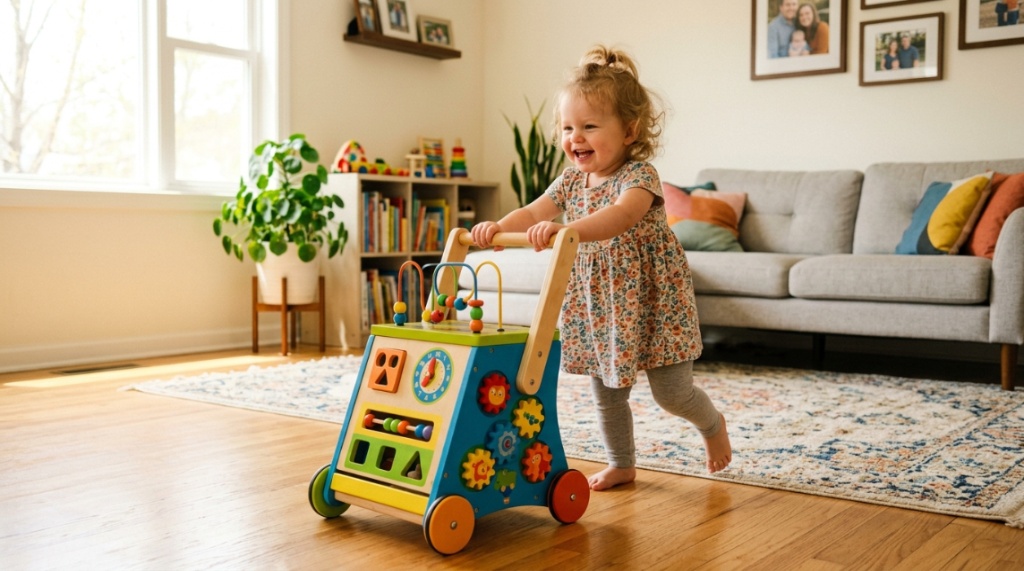
Look for four key features: a wide, grippy base; adjustable resistance; ergonomic handles; and a weighted front. The base must be wider than the distance between your baby’s feet to prevent tipping. Adjustable resistance ensures the walker doesn’t roll too fast for your child’s current skill level. Ergonomic handles should sit at hip height, not chest height, as this encourages a natural arm swing. A weighted front prevents the walker from sliding away when your baby pushes down, which is a common frustration that makes children abandon the toy. Additional features like quiet wheels and a low center of gravity prevent the walker from tipping over when your baby lets go.
Critical Safety Features to Check
- Anti-slip grips on handles to prevent little hands from sliding
- Rubber or silicone wheels that provide friction on hardwood floors
- Round edges with no sharp corners
- Sturdy frame that does not flex when weight is applied
- Clear height markings to ensure the walker grows with your child
Which Type of Push Walker Works Best for Different Flooring?
For hardwood or tile floors, choose a walker with rubber or silicone wheels that provide grip, as plastic wheels will slide too easily and frustrate your child. For carpeted floors, heavier walkers with wider bases are necessary to push through the carpet fibers without bogging down. Wooden push walkers with felt bottoms work well on carpet but can be too heavy for some babies on hard floors. The best option is a walker with adjustable wheel tension, allowing you to tighten the wheels for hardwood or loosen them for carpet. This adaptability ensures your baby experiences consistent resistance regardless of the surface, which is crucial for building predictable balance responses.
| Flooring Type | Recommended Walker Feature | Common Problem to Avoid |
|---|---|---|
| Hardwood / Tile | Rubber wheels, weighted front | Walkers that slide too fast |
| Carpet (low pile) | Wide base, moderate weight | Walkers that get stuck |
| Carpet (high pile) | Heavy wooden frame, large wheels | Wheels that dig into carpet |
| Mixed flooring | Adjustable wheel tension | Inconsistent resistance |
How Can You Use a Push Walker to Improve Stability Step by Step?
Start by placing your baby behind the walker while they are standing, with you kneeling in front of them. Gently place their hands on the handles and encourage them to take one step forward. Repeat this process five times, then let them rest. As they gain confidence, move the walker an inch away from them so they must reach forward, activating their core muscles. The third step is to place a small toy on the walker tray to encourage reaching, which naturally shifts their weight forward. Finally, stand behind them and place your hands on their hips, gently guiding them to shift weight from one leg to the other. This progression takes about two weeks of daily 10-minute sessions. Do not rush this process; if your baby resists, they are not ready for the next step.
As your little one starts moving around the house, safety becomes a 24/7 priority. While you are busy setting up the living room for mobile milestones, pairing your supervision with a reliable Baby Monitor for parents seeking peace of Mind ensures you never miss a moment or a stumble.
What Common Mistakes Do Parents Make With Push Walkers?
The most common mistake is using a push walker as your baby’s sole walking support, which can lead to over-reliance. Parents also often push the walker for their child, which teaches the baby that walking requires external momentum rather than internal effort. Another frequent error is using a walker with toys that require the baby to sit or kneel to play, encouraging poor posture. Avoid walkers that are too tall—if your baby’s arms are fully extended upward, they cannot use their core muscles effectively. Finally, do not leave your baby unsupervised with a push walker near stairs or uneven surfaces, as even the best walkers can tip when the terrain changes unexpectedly.
Can a Push Walker Help Build Confidence in Reluctant Walkers?
Yes, a push walker is remarkably effective for reluctant walkers because it gives them a “security blanket” they can control. Many babies who can stand but refuse to take steps are afraid of the feeling of falling forward. A push walker allows them to control the speed and direction of their movement, which reduces the fear response. For these children, place the walker close to where they typically stand and let them push it toward you. The walker provides a visual anchor that keeps their eyes forward rather than down at their feet, which improves spatial awareness. Over time, they realize that the walker is giving them stability, not moving without them, which transfers confidence to their own body.
How Long Should a Baby Use a Push Walker Each Day?
Use a push walker for no more than 15 minutes per session, with a maximum of two sessions per day. This limit prevents fatigue and ensures the walker remains a learning tool rather than a crutch. After five minutes of pushing, take a two-minute break to allow your baby to stand unaided or hold your hands. This rest period reinforces that walking is about their own balance, not the walker’s support. The total daily time should not exceed 30 minutes, as excessive use can lead to an abnormal gait pattern where the child walks with their feet too far apart, mimicking the walker’s width. Once your baby can take ten consecutive steps independently, reduce walker use to occasional play rather than daily practice.
What Are the Best Exercises to Pair With a Push Walker?
Pair the push walker with three simple exercises to accelerate balance development. First, practice “standing squats” where your baby holds the walker and bends to pick up a toy from the floor, then stands back up. This strengthens leg muscles and teaches controlled descent. Second, try “side stepping” along the walker, where your baby moves sideways rather than forward, developing lateral stability. Third, use the walker in a “stop and go” game where you gently hold the walker still and encourage your baby to take a step without it moving. These exercises convert passive pushing into active coordination training.
How Do You Transition From a Push Walker to Independent Walking?
Transition by gradually moving the walker further away so your baby has to take one independent step to reach it. Start with the walker one foot away, then increase the distance by six inches each week. Next, encourage your baby to push the walker toward you, then turn around and walk back to you without it. The final step is the “drop-off” method: place the walker near a couch, let your baby walk to it, then move the walker away so they must walk back to you. This gradual withdrawal of support should take four to six weeks, depending on your child’s natural development pace. Do not force this transition if your baby shows frustration; instead, let them return to using the walker for a few more days.
Is It Better to Use a Wooden or Plastic Push Walker for Development?
Wooden push walkers are generally better for development because they are heavier and provide more natural resistance, which encourages your baby to engage their core muscles more effectively. Plastic walkers tend to be lighter and can slide too easily, making the baby feel unstable and reducing the push walker baby balance development benefits. However, wooden walkers can be harder to maneuver on carpet. If you choose plastic, ensure it has a water-weighted base that you can fill to add stability. Wooden walkers also have a natural grip that helps babies learn to control their hand pressure, whereas plastic handles can be slippery. For most families, a high-quality wooden push walker with adjustable wheel tension provides the best balance of stability and mobility.
Frequently Asked Questions
What is the difference between a push walker and a baby walker?
A push walker is a stationary toy that the baby stands behind and pushes forward, promoting upright walking. A traditional baby walker is a seated device that surrounds the baby and allows them to glide with their feet, which can delay walking and create unsafe momentum.
Can a push walker help a baby who is already walking but unsteady?
Yes, push walkers are excellent for babies who are walking but lack confidence in their balance. They provide a safety net that lets the child practice turning, stopping, and walking on different surfaces without the fear of falling.
At what age should a baby stop using a push walker?
Most babies naturally stop using push walkers between 14 and 18 months, once they can walk, run, and navigate their environment confidently. If your child is still using the walker after 18 months, gradually withdraw it to encourage complete independence.
Are push walkers safe for babies with developmental delays?
Push walkers can be beneficial for babies with mild motor delays, but always consult your pediatrician or physical therapist first. For some delays, a walker may reinforce incorrect movement patterns, while for others, it provides needed support for strength building.
How do I clean and maintain a push walker?
Wipe down plastic parts with a mild soap solution and a damp cloth weekly. For wooden walkers, use a wood-safe cleaner and wax the wheels every two months. Check the wheel tension monthly and ensure no screws have loosened from regular use.
Can a push walker replace physical therapy for walking issues?
No, a push walker is a supportive tool, not a medical device. If your child has diagnosed motor delays, toe-walking, or muscle tone issues, work with a physical therapist who can recommend specific support strategies that may or may not include a push walker.
What should I do if my baby refuses to use the push walker?
Do not force it. Place the walker in a play area with no expectation to push it. Sometimes babies need to explore the walker as a toy first, pressing buttons or playing with it from a seated position, before they feel ready to stand and push it.
Conclusion
Choosing the right push walker is just the first step in your baby’s walking journey. The real magic happens when you use it intentionally, in short sessions, as part of a broader physical development plan. You now know to wait for the right developmental window, choose a walker with a wide base and adjustable resistance, and combine pushing with core-strengthening exercises. Remember that every baby develops at their own pace—the walker is a tool, not a race. Start with the exercises outlined here, be patient with setbacks, and celebrate each independent step your baby takes. Watch your child’s confidence grow as they learn to balance not just on the walker but on their own two feet.