You have finally decided to ditch the pavement and hit the dirt. That is exciting, but standing in a sea of spokes, suspension jargon, and price tags can feel paralyzing. The biggest mistake beginners make is buying a bike that looks cool but rides poorly on actual trails. You need a mountain bike for beginners that fits your budget, your local terrain, and your skill level. This guide breaks down every decision you need to make, from frame material to tire tread, so you walk out of the shop with confidence instead of buyer’s remorse.
What Exactly Defines a Mountain Bike for Beginners?
A mountain bike for beginners + first mountain bike is a bike designed to handle off-road terrain while forgiving the inevitable mistakes of a new rider. It typically features wider tires with aggressive tread, a sturdy frame, and a lower gear range for climbing hills without excessive strain.
Beginner bikes prioritize stability over speed and durability over weight savings. You do not need a carbon fiber frame or a fork with 160 millimeters of travel right now. You need geometry that keeps you upright and in control. Look for a hardtail model (front suspension only) or a low-travel full suspension bike if your budget exceeds $1,500. The most important characteristic is that the bike inspires confidence rather than fear when you hit a root or a loose corner.
Key Features to Look For
- Frame material: Aluminum is the sweet spot for beginners. It is strong, lightweight enough, and affordable. Steel is heavier but more compliant on rough trails. Avoid cheap hi-ten steel on department store bikes.
- Suspension travel: 100 to 120 millimeters for a hardtail. This absorbs small bumps without wasting your pedal power.
- Brakes: Hydraulic disc brakes are non-negotiable for safety and control in wet or muddy conditions.
- Dropper post: Not essential for a first bike, but a huge quality-of-life upgrade if your budget allows.
Why Is Choosing the Right Frame Size So Critical?
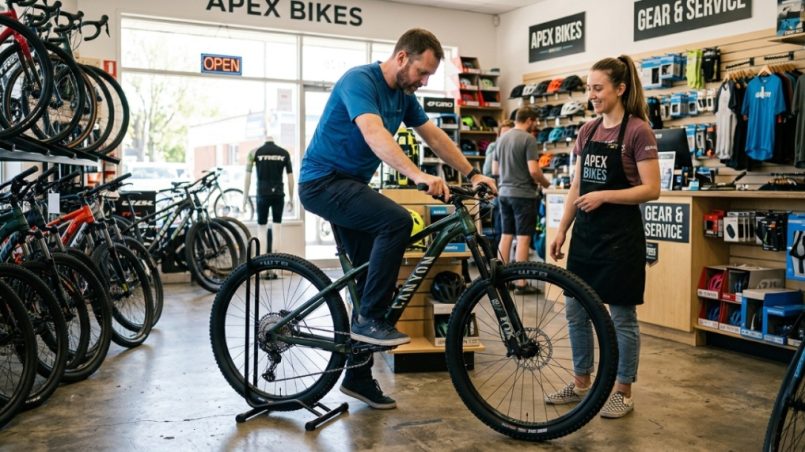
Riding a frame that is too large or too small is the quickest way to hate mountain biking. When you sit on the saddle, you should have a slight bend in your knee at the bottom of the pedal stroke, and you should be able to stand over the top tube with both feet flat on the ground and a few inches of clearance.
A bike that fits properly puts you in control. You can shift your weight back on descents and forward on climbs without fighting the geometry. Most manufacturers provide size charts based on your height and inseam measurement. Do not guess. Visit a local bike shop and sit on several sizes. Even if you plan to buy online, test the fit in person first. An improperly sized bike leads to back pain, poor handling, and a higher risk of crashing.
Which Type of Suspension Is Best for a First Mountain Bike?
Hardtail bikes (front suspension only) are the best choice for a mountain bike for beginners + first mountain bike. They cost less, weigh less, require less maintenance, and teach you proper body positioning and line choice. Without rear suspension, you learn to use your legs as shock absorbers, which makes you a better rider in the long run.
Full suspension bikes are more comfortable on rough, rocky terrain, but they are significantly more expensive for a quality model. A cheap full suspension bike under $1,000 will have heavy, inefficient rear linkages and poor damping. You are better off with a solid hardtail at that price point. Save full suspension for after you have developed basic skills and know that you will stick with the sport.
How Much Should You Spend on a First Mountain Bike?
Plan to spend between $800 and $1,500 for a new bike that will not hold you back. Below $800, you enter the realm of heavy components, unreliable brakes, and suspension that functions more like a pogo stick than a shock absorber. Bikes in the $1,000 to $1,500 range from reputable brands like Trek, Giant, Specialized, and Cannondale offer reliable drivetrains, hydraulic disc brakes, and frames that can handle years of abuse.
The used market can stretch your dollar further, but you need to know what to look for. Check for cracks in the frame, excessive play in the suspension linkage, and worn drivetrain components. If you are not mechanically inclined, stick with a new bike from a local shop that includes a free tune-up after the first few rides.
Price Breakdown Comparison
| Price Range | What You Get | Recommendation |
|---|---|---|
| Under $500 | Heavy steel frame, coil spring suspension, mechanical disc brakes | Avoid unless absolutely necessary for budget |
| $500 to $800 | Aluminum frame, basic air fork, entry-level drivetrain | Okay for very casual trail riding |
| $800 to $1,200 | Quality aluminum hardtail, reliable hydraulic brakes, solid components | Sweet spot for beginners |
| $1,200 to $1,500 | Better suspension fork, dropper post option, lighter wheels | Ideal for committed beginners |
What Type of Tires Should a Beginner Look For?
Beginner mountain bike tires should have moderate tread with closely spaced knobs in the center and more aggressive knobs on the edges. This pattern rolls efficiently on hardpack dirt and pavement while providing traction when you lean into corners. Tire width should be between 2.25 and 2.4 inches. Wider tires provide more stability and traction at lower pressures, which helps a beginner stay upright on loose terrain.
Tubeless-ready tires are worth the investment. They allow you to run lower tire pressures (around 20 to 25 PSI) without pinch-flatting, which dramatically improves grip and comfort. Many bikes in the beginner price range come with tubes, but you can convert to tubeless later with a simple kit.
Can You Buy a Mountain Bike Online as a Beginner?
You can buy online, but you should not unless you have experience assembling and tuning a bicycle. An online bike arrives in a box with the handlebars, front wheel, pedals, and seat post unattached. You need to align the brakes, adjust the derailleur, install the pedals with the correct torque, and properly set the suspension sag. Getting this wrong makes the bike unsafe or frustrating to ride.
If you choose to buy online, pay a local bike shop to assemble and tune the bike for you. Most shops charge between $75 and $150 for a full assembly. Factor that into your budget. Alternatively, consider a direct-to-consumer brand like Canyon or Vitus that offers excellent value and detailed assembly guides, but again, factor in professional assembly unless you are mechanically confident.
For a reliable and affordable option in this category, we have reviewed a solid candidate that balances cost with trail-ready performance. You can read our full thoughts on this mountain bike for beginners to see how it stacks up against traditional bike shop offerings.
How Important Is the Drivetrain for a Beginner?
The drivetrain determines how efficiently you climb hills and how smoothly you shift. For a first bike, you want a 1x drivetrain, meaning one chainring in the front and a wide-range cassette in the back. This eliminates the confusing front derailleur and gives you all the gear range you need for climbing and descending without complicated shifting patterns.
Look for an 11-speed or 12-speed system from Shimano Deore or SRAM NX. These are durable, reliable, and easy to adjust. Avoid entry-level 7- or 8-speed drivetrains with three chainrings in the front. They are heavier, harder to maintain, and less intuitive for a new rider.
When Should You Upgrade from a Beginner Bike?
You should consider upgrading when you start feeling limited by the bike’s capabilities rather than your own skills. If you are bottoming out the suspension on drops, struggling to maintain traction on steep climbs, or riding trails that consistently demand more travel or better geometry, it is time to look at a mid-range full suspension bike or a more aggressive hardtail.
Most riders reach this point after one to two seasons of consistent riding. Before upgrading, invest in contact point improvements: better pedals, a comfortable saddle, and wider handlebars. These cheap upgrades can transform how a bike feels without buying a whole new frame.
What Should You Budget for Essential Gear Beyond the Bike?
Your budget must include a quality helmet with MIPS technology, which costs $75 to $150. A helmet is the single most important piece of gear you will ever buy. You also need gloves, a pair of flat or clip-in pedals, a spare tube, a mini pump, and a multi-tool. Budget an additional $150 to $250 for these accessories.
Do not skimp on the helmet to save money for a slightly better bike. A helmet is a non-negotiable safety device, not a discretionary purchase. Buy the helmet in person so you can ensure it fits snugly without pressure points.
When looking at your options, pay close attention to the drivetrain. Beginners often benefit from a wider gear range to handle sudden climbs. For instance, choosing a 21 Speed Mountain Bike for Smooth and Efficient Riding gives you the versatility needed to transition seamlessly from flat pavement to steep dirt inclines.
Essential Gear Checklist
- MIPS helmet
- Full-finger gloves
- Hydration pack or water bottle cage
- Flat pedals or entry-level clipless pedals and shoes
- Multi-tool with chain breaker
- Tire levers and spare tube or tubeless plug kit
- Mini pump or CO2 inflator
Frequently Asked Questions
Is a full suspension mountain bike worth it for a beginner?
Generally, no. A hardtail is more affordable, easier to maintain, and better for learning proper riding technique. Only consider full suspension if your local trails are extremely rocky and rooty, and your budget exceeds $1,500.
How do I know if a used mountain bike is a good deal?
Check the frame for cracks, especially around welds and suspension pivots. Spin the wheels to check for true. Shift through all gears and test the brakes. If the drivetrain is worn or rusty, factor in a $150 to $300 replacement cost.
Can I ride a mountain bike on the road?
Yes, but it will be slower and louder than a road bike or hybrid. Knobby tires create rolling resistance. You can swap to smoother tires if you ride mostly on pavement, but then you lose off-road capability.
What is the best wheel size for a beginner mountain bike?
27.5-inch wheels are nimble and easier to maneuver, while 29-inch wheels roll over obstacles more easily. For most beginners, 29-inch wheels are the better choice because they offer more stability and momentum. Riders under 5 feet 4 inches may prefer 27.5-inch wheels for better fit.
How often should I service my first mountain bike?
Clean and lubricate the chain after every muddy ride. Check brake pad wear and tire pressure before every ride. Take the bike to a shop for a full tune-up every six months or after 100 hours of riding, whichever comes first.
Should I buy a mountain bike with a dropper post?
If your budget allows, yes. A dropper post lets you lower the saddle on descents for better body positioning. It is one of the most impactful upgrades you can make. Many bikes in the $1,200+ range include a dropper post stock.
What if I am between two frame sizes?
Size down if you want a more playful, maneuverable bike. Size up if you prioritize stability and a more comfortable stretched-out position. Test ride both if possible. The difference can significantly affect your confidence on descents.
Final Thoughts on Choosing Your First Mountain Bike
Your first mountain bike should be a tool for progression, not a status symbol. Focus on fit, durability, and reliability within your budget. A solid hardtail with hydraulic disc brakes, a 1x drivetrain, and a decent air fork will serve you well for years and let you develop skills you will carry onto any future bike. Do not overthink wheel size or brand prestige. Buy from a shop that treats you well, get the helmet first, and then spend your money on trail access and riding time. The best bike in the world is useless if you are not riding it. Get out there, fall down a few times, and enjoy every dusty, muddy, thrilling moment of the journey.