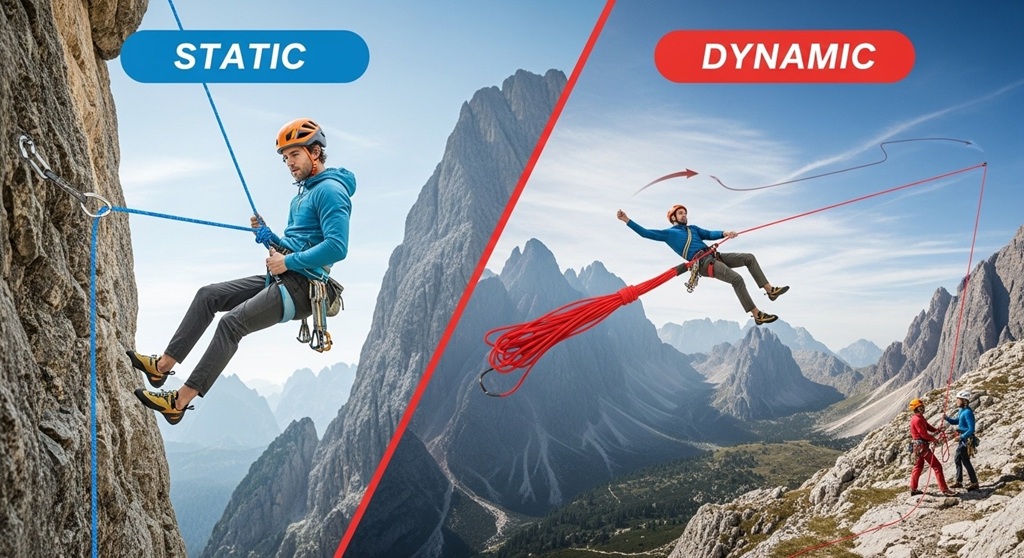
A dynamic rope stretches to absorb the force of a fall. A static rope does not. That difference in elasticity directly affects safety, fall protection, and intended use.
If you choose the wrong rope, the consequences are real. A rope that doesn’t stretch during a lead fall can transmit extreme force to the climber, harness, anchor, and protection points. On the other hand, a rope that stretches too much during rappelling or rescue work can reduce efficiency and control.
This is why understanding rope elasticity differences is not optional. It’s fundamental.
In this detailed climbing rope comparison, we break down how each rope works, where it performs best, what safety standards say, and how to choose the right one for your specific climbing style.
Why Does Rope Elasticity Matter in Climbing?
Short answer: Rope elasticity reduces impact force during a fall and protects both the climber and gear.
When a climber falls, gravity converts potential energy into kinetic energy. That energy must go somewhere. A dynamic rope stretches to absorb it. A static rope does not stretch much, so it transfers force directly to the system.
Understanding Impact Force
Impact force is measured in kilonewtons (kN). According to UIAA testing standards:
- Dynamic ropes must limit impact force to approximately 12 kN or less (single ropes).
- Typical dynamic ropes stretch 30–40% under UIAA fall testing.
- Static ropes stretch around 2–5% under body weight load.
That elasticity gap is the core of the debate. In real-world terms:
- A dynamic rope acts like a shock absorber.
- A static rope acts like a fixed line.
This difference affects lead climbing, top-roping, rappelling, rescue operations, and industrial rope access.
What Is a Dynamic Climbing Rope?
Short answer: A dynamic rope is designed to stretch under load to absorb fall energy during lead climbing.
How Is It Built?
Dynamic ropes use a kernmantle construction:
- Kern (core): Twisted nylon fibers designed for elasticity.
- Mantle (sheath): Protective woven layer for abrasion resistance.
The nylon core is engineered to elongate under sudden force. That controlled stretch reduces peak impact force.
Where Is It Used?
- Lead climbing (sport and trad)
- Indoor climbing gyms
- Multi-pitch routes
- Mountaineering
- Ice climbing
Types of Dynamic Ropes
- Single ropes – Used alone. Most common.
- Half ropes – Used in pairs. Ideal for trad routes.
- Twin ropes – Clipped together for redundancy.
Real-World Case Example
In a UIAA standardized drop test (80 kg mass, 5-meter fall), dynamic ropes are tested for multiple falls while maintaining safe impact force levels. Many certified ropes withstand 5–9 such test falls before failure. That durability proves their energy absorption capability.
Without this stretch, anchors and protection pieces would experience far higher loads, increasing failure risk.
What Is a Static Climbing Rope?
Short answer: A static rope is designed to minimize stretch for hauling, rappelling, rescue, and fixed-line work.
How Is It Built?
Static ropes also use kernmantle construction, but the internal fibers are tightly woven to reduce elongation. Under load, they stretch very little.
Where Is It Used?
- Rappelling
- Fixed rope ascents
- Caving
- Rescue operations
- Industrial rope access
- Tree climbing and arborist work
Why Not Use Static for Lead Climbing?
Because minimal stretch means higher impact force during a fall. That force can:
- Increase risk of anchor failure
- Cause gear to rip out
- Increase injury risk
Static ropes are efficient for vertical movement but not designed to absorb dynamic falls.
How Do Rope Elasticity Differences Affect Safety?
Short answer: Dynamic ropes reduce injury risk during falls. Static ropes improve control in fixed systems.
| Feature | Dynamic Rope | Static Rope |
|---|---|---|
| Stretch under load | High (30–40% test stretch) | Low (2–5%) |
| Fall protection | Yes | No |
| Best for lead climbing | Yes | No |
| Best for rappelling | Acceptable | Excellent |
| Impact force absorption | High | Low |
This climbing rope comparison shows the functional divide clearly.
Which Rope Should You Choose for Your Climbing Style?
Short answer: Choose dynamic rope for fall protection. Choose static rope for fixed-line work.
Choose Dynamic Rope If You:
- Lead climb indoors or outdoors
- Trad climb with gear placements
- Climb multi-pitch routes
- Need certified fall protection
Choose Static Rope If You:
- Rappel frequently
- Perform rope access work
- Haul equipment
- Climb fixed lines
If you’re comparing options, review this detailed guide on
climbing rope comparison
to evaluate specifications, diameter, and construction before buying
What Do Safety Standards Say About Static vs Dynamic Ropes?
Short answer: Dynamic ropes must meet UIAA and EN 892 standards. Static ropes follow EN 1891 standards.
Dynamic Rope Standards
- UIAA 101
- EN 892
These standards test impact force, elongation, sheath slippage, and number of falls held.
Static Rope Standards
- EN 1891 (Type A and B)
These focus on low stretch, tensile strength, and abrasion resistance.
Using a rope outside its certified purpose can void safety ratings and increase risk.
Is Static Rope Stronger Than Dynamic Rope?
Short answer: Static ropes often have higher tensile strength, but that does not mean they are safer for falls.
Tensile strength measures how much weight a rope can hold before breaking. But climbing safety is about managing sudden forces, not just holding static weight.
Dynamic ropes may have lower maximum tensile ratings than static ropes, yet they are safer for falling scenarios because they reduce peak impact force.
This is a critical distinction many beginners overlook.
How Long Do Static and Dynamic Ropes Last?
Short answer: Lifespan depends on use, storage, and fall exposure.
General Manufacturer Guidelines:
- Unused rope: Up to 10 years
- Occasional use: 3–5 years
- Frequent use: 1–3 years
- Major fall event: Consider immediate retirement
Dynamic ropes degrade faster under repeated falls due to fiber fatigue. Static ropes wear from abrasion and environmental exposure.
Regular inspection is non-negotiable.
Can You Use a Static Rope for Top Roping?
Short answer: It is not recommended.
Even in top-rope scenarios, climbers can generate fall forces. Dynamic rope reduces that force and protects anchors.
Static ropes may be used in specialized training environments under strict supervision, but standard practice favors dynamic rope.
Conclusion: Which Rope Is Right for You?
Here’s the reality.
Using the wrong rope increases risk. Not understanding rope elasticity differences leads to poor decisions. And poor decisions in climbing have consequences.
If you lead climb, choose dynamic rope. If you manage fixed systems, use static rope. Never mix purposes.
Climbing is already complex. Your rope choice should not be guesswork.
Before your next climb, review specifications carefully. Compare diameter, impact force rating, elongation percentage, and certification standards. If you’re upgrading gear, start with a structured climbing rope comparison and choose equipment that matches your climbing discipline.
Take action now: Evaluate your current rope. Check its age. Check its certification. Make sure it matches how you climb. Safety starts with informed choices.
Frequently Asked Questions (FAQs)
1. Can I use a static rope for sport climbing?
No. Sport climbing involves lead falls. Static rope does not absorb fall energy safely. Always use a certified dynamic rope.
2. What is the typical stretch percentage of a dynamic rope?
Dynamic ropes can stretch up to 30–40% in UIAA fall tests. Under body weight, static elongation is usually around 6–10%.
3. Are static ropes more durable?
Static ropes resist abrasion well and handle hauling effectively. However, durability depends on use conditions, exposure to dirt, moisture, and UV light.
4. What diameter should I choose for a dynamic rope?
Most single dynamic ropes range from 9.4 mm to 10.2 mm. Thinner ropes are lighter but may wear faster. Thicker ropes offer durability but add weight.
5. Do dynamic ropes lose elasticity over time?
Yes. Repeated falls and environmental exposure reduce elasticity. If a rope feels stiff or shows sheath damage, consider replacing it.
6. Is rope certification important?
Yes. Look for UIAA or CE markings. Certification ensures the rope meets tested safety standards.
7. How should I store climbing rope?
Store it in a cool, dry place away from direct sunlight and chemicals. Avoid prolonged UV exposure and sharp edges.
Related Topic: How to Pick a Compact Tape Measure for Everyday Carry
Read Next: Zoning the garden – making outside ‘rooms’