Key Takeaways
- Flexible leases let you move with less notice, but they often cost more.
- Month-to-month rent can rise with proper notice.
- A six-month lease often costs less than a month-to-month deal.
- Early termination fees on fixed leases can reach one to three months’ rent.
- Always read renewal, notice, and fee terms before you sign.
Life does not always fit a 12-month lease. A job may change, a family may grow, or plans may shift. Therefore, many renters look for flexible lease terms. These options give you more freedom, but they come with trade-offs. Rent is often higher, and rules vary by landlord and state. This guide explains what renters should know about flexible lease terms. It covers lease types, costs, risks, and smart ways to negotiate. Use it to pick the right agreement for your situation.
What Flexible Lease Terms Mean
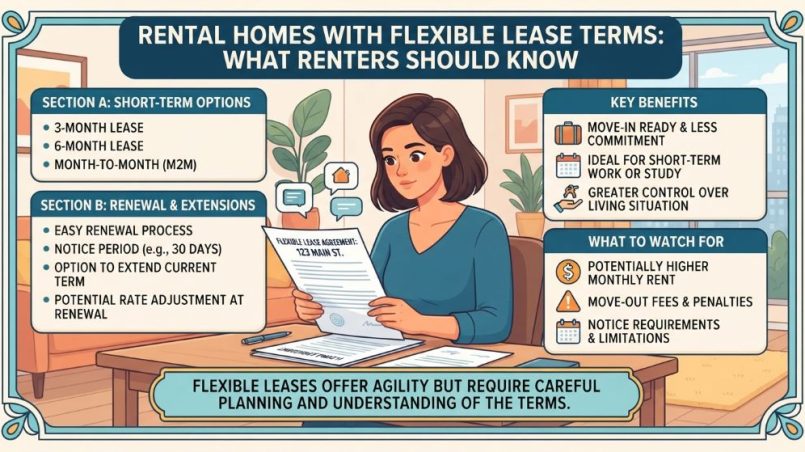
A flexible lease is any agreement shorter or more adaptable than a standard 12-month lease. One renter guide describes it as a contract that lets you move or stay without a rigid commitment. Several types exist, and each works differently.
The most common option is a month-to-month lease. It renews automatically each month until the landlord or tenant gives written notice. Avail describes it as a lease that continues until someone ends it. Notice periods are often short. The same source says 15 to 30 days is typical, though local law and your lease control the exact time.
Another option is a short-term fixed lease. These leases usually run three to six months. Apartment List says common lengths are one, three, and six months. A fixed end date gives you clearer terms than month-to-month. However, you are locked in until that date.
Some landlords also offer flexible options inside a longer lease. Examples include lease transfers, sublet permission, or a shorter notice period. These features vary widely, so ask before you sign.
Here is a quick comparison:
- Month-to-month: Highest flexibility, but rent can change with notice.
- Short-term fixed lease: Set end date, often three to six months.
- Standard 12-month lease: Lower rent, but early exit can be costly.
- Lease with special terms: Custom rules for subletting or early exit.
Additionally, many renters end up month-to-month by accident. One guide notes that most states convert a fixed lease to month-to-month when a tenant stays after it ends without signing a new one. Therefore, check what happens when your lease expires.
The Real Cost of Flexibility
Flexibility rarely comes free. Landlords face higher turnover and more vacancy risk. As a result, they usually charge a premium.
The size of that premium is hard to pin down. Steadily notes that no well-documented national survey measures it. Instead, industry estimates range widely from about 5 percent to 40 percent. Other guides give narrower ranges. One puts the month-to-month premium at 15 to 30 percent. Another says 20 to 40 percent. Therefore, treat these numbers as rough guides and compare local listings.
Consider an example from BrightPlace. On an $1,800 apartment, a 20 percent premium adds $360 each month. Over six months, that equals $2,160. That is a large price for flexibility.
Shorter fixed leases often cost less. The same source says six-month leases often carry a 5 to 15 percent premium over 12-month rates. Consequently, a six-month lease may give you a clear exit date at a lower cost than month-to-month.
Compare that with breaking a standard lease. BrightPlace says early termination fees typically equal one to two months’ rent. Another guide says they can reach three months. In some cases, you may owe the remaining rent instead.
Skybriz offers a helpful break-even idea. If you stay less than about ten to eleven months, month-to-month rent may cost less than paying to break a fixed lease. However, if you stay longer, the 12-month lease usually wins.
Use these steps to compare costs:
- Ask for rent quotes on month-to-month, six-month, and 12-month terms.
- Multiply the monthly difference by your expected stay.
- Add possible early termination fees to the 12-month option.
- Include moving costs and deposits for each choice.
Finally, remember that furnished units and utilities can shift the total. Ask what is included in each quote.

Risks and Terms to Check Before Signing
Flexible leases carry hidden risks. Therefore, read every clause before you sign. A few small terms can change your costs and security.
First, check rent increase rules. On a month-to-month lease, rent can change with proper written notice, according to Steadily. A fixed-term lease locks rent until renewal. So a flexible lease may leave you less protected from increases. Ask how much notice the landlord must give.
Second, confirm the notice period for leaving. Flexible leases typically allow exit with 30 to 90 days’ notice, according to one renter guide. Meanwhile, fixed leases may allow no exit without a fee. Make sure the lease states exactly how and when to give notice, and whether it must be in writing.
Third, watch for automatic renewals. One guide warns that some short-term leases convert to 12-month leases at expiration. If you miss the notice window, you could be locked in. Set a calendar reminder well before the lease ends.
Fourth, review security and fees. Ask about the deposit, cleaning fees, and move-out charges. Short leases sometimes carry higher fees because landlords must turn over the unit more often.
Fifth, understand landlord rights. Month-to-month tenants may face shorter notice if the landlord decides to sell or renovate. Avail notes that this arrangement makes it easier for landlords to change plans. Therefore, do not rely on month-to-month if you need stable housing for a family or school year.
Watch for these red flags:
- Vague notice rules: The lease does not state who must give notice and when.
- Hidden fees: Charges appear that were not in the listing.
- No written agreement: Verbal deals are hard to prove.
- Unclear renewal terms: The lease does not explain what happens at the end.
Finally, know your local laws. Rules vary by state and city. Check your state’s tenant rights page or speak with a local housing counselor.
How to Negotiate and Choose the Right Term
You can often get more flexibility without paying full price. Landlords want good tenants and full units. Therefore, negotiation works more often than renters expect.
Start by asking directly. Skybriz notes that landlords often have room to adjust lease length, rent, and terms when asked. A tenant with stable income and good references has more leverage. Additionally, a longer commitment gives you more negotiating power. If you can offer 12 months, you may win a lower rent or a better exit clause.
Try these strategies:
- Ask for a break clause. Request permission to leave after six months with 60 days’ notice.
- Negotiate a lower fee. Ask for an early termination fee of one month instead of two.
- Request sublet or transfer rights. These let you pass the lease to someone else.
- Start with a fixed lease. Later, convert to month-to-month at the same rent if the landlord agrees.
- Compare landlords. Some properties charge no premium at all.
Timing also matters. Rents often peak in warm months, so a winter search may give you better terms. Additionally, off-season vacancies make landlords more flexible.
Match the lease type to your situation. Choose month-to-month if your plans are truly uncertain, such as a job search or home purchase. Choose a six-month lease if you know your end date. Pick a 12-month lease if you plan to stay and want the lowest rent.
Finally, get everything in writing. Save the lease, emails, and receipts. Take dated photos at move-in. Buy renter’s insurance, which is inexpensive and covers your belongings.
Conclusion
Flexible lease terms give renters freedom, but they usually cost more. Month-to-month leases offer the most flexibility. However, six-month leases often balance cost and control better. Additionally, watch for rent increases, renewal traps, and fees. When you compare total costs and negotiate smartly, you can find a lease that fits your life.
Take action today. Write your expected stay length, and ask three landlords for quotes on different lease terms. Then compare the total cost of each option. Share your best lease tip in the comments, and subscribe to our newsletter for more practical rental advice.
Frequently Asked Questions
What is a flexible lease term?
It is any lease shorter or more adaptable than a 12-month fixed lease. Examples include month-to-month and short-term leases.
Is month-to-month rent more expensive?
Usually yes. Estimates range widely, from about 5 to 40 percent higher, so compare local quotes.
Can a landlord raise rent on a month-to-month lease?
Yes, with proper written notice. Check your lease and local law for the required notice period.
How much does it cost to break a 12-month lease?
Fees often equal one to two months’ rent, and sometimes more. Some landlords ask for the remaining rent instead.
Can I negotiate a flexible lease?
Often yes. Ask for a break clause, a lower fee, or sublet rights. Stable income and good references help.